

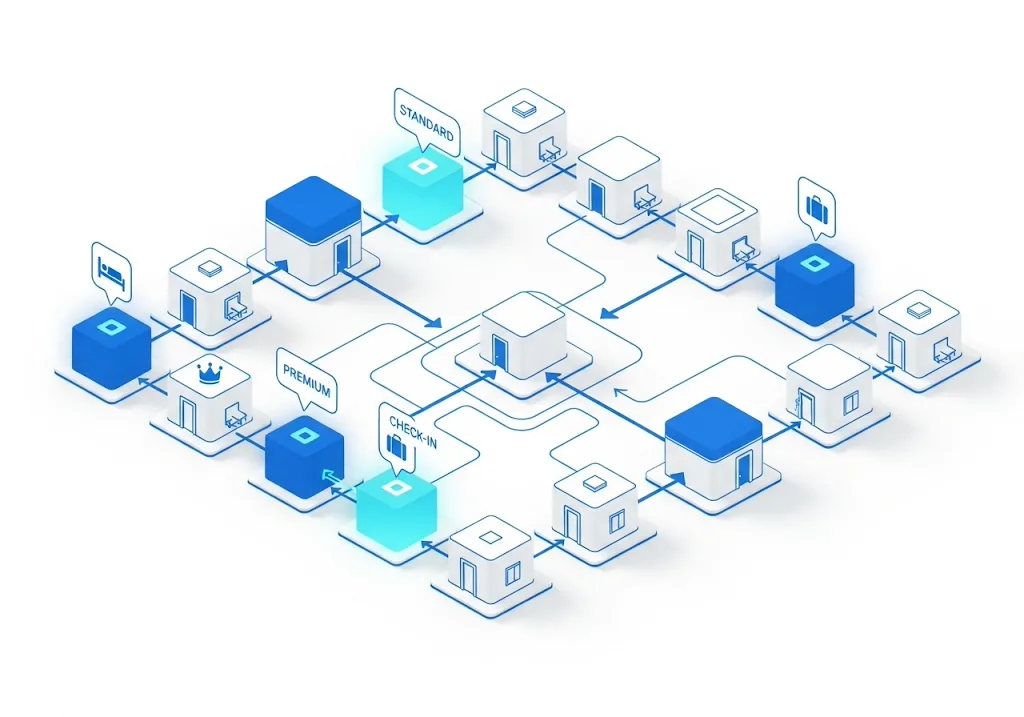
Cross-Center Demand & Capacity
One guest creates demand everywhere at once - total RM allocates shared capacity across centers before the stay begins.
hubThe Connected House
The same arrival floods every center in sequence: breakfast covers at 8am, spa curiosity by noon, bar seats at 7pm. One guest, one booking, five demand events - and the room book knew about all of them weeks in advance.
That is why each center's demand forecast should be derived from the shared book: room nights on the books, the event calendar and local demand drive the outlet forecasts. The arrival is not news to the PMS; it should not be news to the kitchen either.
Properties that forecast outlets independently of the room book are surprised daily - staffed for a quiet Tuesday that 300 arrivals turn into a scramble, or braced for a rush that never leaves the bedrooms.

tuneSix Allocation Decisions
Room-to-Outlet Planning
Stay patterns and arrival mix driving outlet staffing and stock - the room book becomes the outlet plan.
Shared Inventory Release
Cabanas, tables and slots reserved for in-house guests, released to the public at the right hour.
Compression Staffing
Cross-trained teams shifted toward whichever center the day compresses.
Advance-Slot Holding
Prime spa and dining slots held back from discount channels for full-rate guests.
Package Capacity Caps
Bundled offers capped so they fill centers rather than flood them.
Displacement Review
Big decisions priced across centers, not within one - every displaced cover counted.
compare_arrowsCenter-Siloed vs Shared Forecast
The siloed house is a set of departments guessing alone. Each outlet builds its own forecast from its own narrow history, and each is shocked by the same busy week the room book predicted months earlier.
The shared house runs one book through every center. The same demand signal - arrivals, events, city compression - drives the restaurant prep list, the spa schedule and the parking rotation at once.
The difference is not software; it is governance. One forecast, owned centrally and consumed by every center, with each department planning against the same numbers.
descriptionSiloed Forecasting
Each department guessing alone; outlets shocked by busy weeks the room book saw coming.
insightsShared Forecasting
One book feeding every center - the house moves together, staffed and stocked for the same day.
monitoringThe Shared Bloodstream
Treat capacity - rooms, tables, slots, seats, parking bays - as one shared bloodstream the whole property draws on, not as five private tanks owned by five departments.
Allocated centrally, it changes how the house runs: staffing lands where the day actually compresses, prime inventory reaches the guests who value it most, and every center prices with knowledge of the others.
The bottom line: capacity is the property's shared bloodstream. Hotels that plan it centrally staff precisely, price confidently and stop rediscovering their own demand every morning.
translatePenjelasan dalam Bahasa Indonesiaexpand_more
Alokasi kapasitas lintas center (cross-center capacity allocation) adalah praktik mengelola permintaan yang lahir serentak di seluruh properti dari satu kedatangan tamu. Satu booking memicu covers sarapan pagi, rasa penasaran spa siang hari, dan kursi bar malam. Total RM mengalokasikan kapasitas bersama ini sebelum stay dimulai, diturunkan dari satu forecast yang sama.
- check_circleKedatangan tunggal menciptakan rangkaian permintaan: breakfast covers pukul 8, spa siang, bar malam; diketahui room book jauh hari.
- check_circleForecast tiap center diturunkan dari shared book: room nights, event calendar, dan permintaan lokal menggerakkan outlet.
- check_circleEnam keputusan alokasi: room-to-outlet planning, shared inventory release, compression staffing, advance-slot holding, package capacity caps, displacement review.
- check_circlePrime slot spa dan dining ditahan dari channel diskon demi tamu full-rate; paket dibatasi agar mengisi, tidak membanjiri.
- check_circleSiloed vs shared forecasting bukan soal software melainkan governance: satu forecast dimiliki pusat, dikonsumsi semua center.
- check_circleKapasitas adalah aliran darah bersama properti; dialokasikan sentral, staffing mendarat tepat dan harga dibuat sadar lintas center.
helpPertanyaan Umum (FAQ)
Apa itu alokasi kapasitas lintas center di hotel?
Alokasi lintas center adalah pengelolaan kapasitas bersama, seperti meja, slot, dan parkir, secara sentral sebelum stay dimulai. Keputusannya mencakup pelepasan inventori bersama, penahanan slot prima, batas kapasitas paket, dan reviu displacement. Satu kedatangan menciptakan permintaan serentak di banyak center yang sudah terbaca di room book.
Mengapa forecast outlet harus diturunkan dari room book?
Kedatangan yang sama memicu covers sarapan pukul 8, rasa penasaran spa menjelang tengah hari, dan kursi bar pukul 7 malam. Properti yang meramalkan outlet secara terpisah kaget setiap hari oleh minggu sibuk yang sudah terprediksi berminggu-minggu sebelumnya. Kedatangan bukan berita bagi PMS, dan seharusnya bukan berita bagi dapur.
Apa perbedaan forecasting siloed dan shared?
Rumah silo adalah kumpulan departemen yang menebak sendiri dari sejarah sempit sehingga semuanya kaget oleh minggu sibuk yang sama. Rumah shared menjalankan satu book ke seluruh center: sinyal demand yang sama menggerakkan prep list, jadwal spa, dan rotasi parkir sekaligus. Bedanya bukan software, melainkan governance.